Biodata vs Resume: What's the Difference
Marriage Biodata Maker Team · · 5 min read
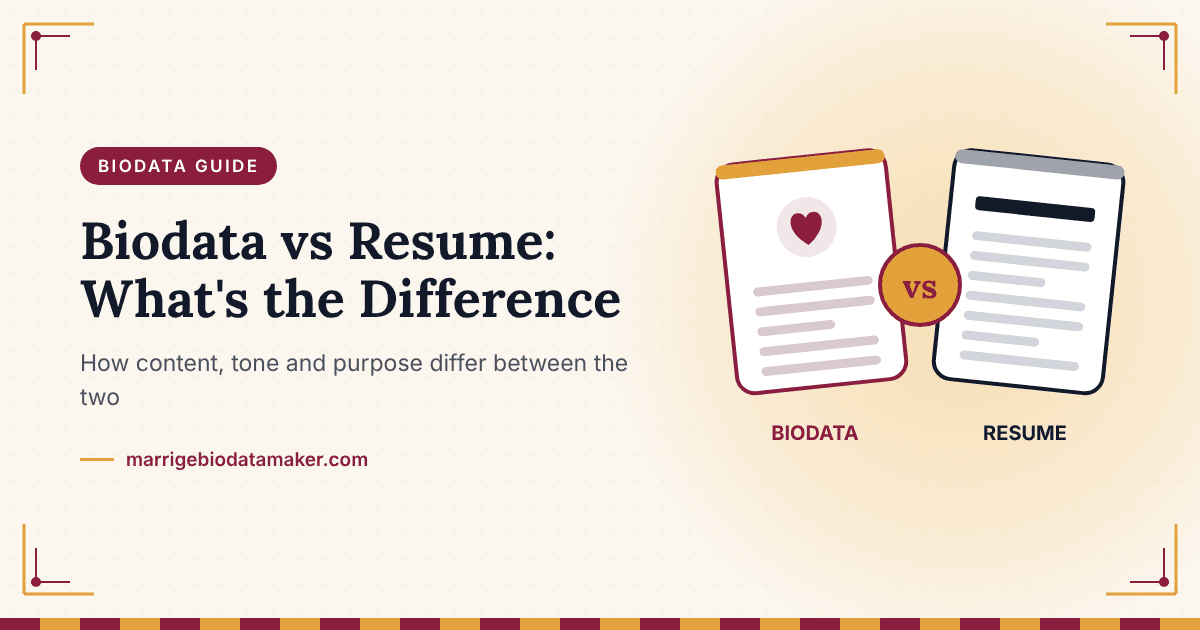
Both documents are one-page summaries with sections and a photo, which is why people sometimes confuse the two. But a marriage biodata and a job resume are written for different readers, with different goals — and that changes what belongs in each.
Different purpose
A resume convinces an employer you can do a job. A marriage biodata gives a prospective family enough information to judge compatibility — for marriage, not employment. That single difference shapes everything else.
Different content
| Resume | Marriage biodata |
|---|---|
| Work experience, in detail | Current role, briefly |
| Skills and certifications | Family background |
| Achievements and projects | Personal details (height, diet, horoscope) |
| Professional summary | Personal interests and preferences |
| References | Contact details (often a parent's) |
A resume is almost entirely about career. A biodata spends most of its space on family and personal details, with career reduced to a line or two.
Different tone
A resume is written to persuade — action verbs, quantified achievements, a pitch for why you're the best candidate. A biodata is written to inform. Families are looking for an honest, factual picture, not a sales pitch, so overly promotional language ("dynamic self-starter") feels out of place.
Different photo
A resume photo, where used at all, is a professional headshot. A biodata photo is usually a clear, recent, informal portrait — families want to see what you actually look like day to day, not a corporate photo.
What carries over
A few habits from good resume-writing still apply:
- Keep it to one page where possible
- Use consistent formatting throughout
- Proofread carefully — typos undermine both documents equally
- Lead with what matters most to the reader
A side-by-side example
The same person describes their job differently in each document.
In a resume:
Led a team of 5 engineers to deliver a payments module, reducing checkout failures through a redesigned retry flow. Skills: Java, SQL, AWS.
In a marriage biodata:
Software engineer at an IT company, Bengaluru. 5 years of experience.
The resume lists what you did and the tools you used. The biodata gives the reader just enough to understand your profession, stability and city, then moves on to the sections a family cares about more.
Sections a resume never has
Several sections exist only in a biodata, and leaving them out makes the page feel incomplete to a family:
- Family background: parents' occupations, siblings, family type and native place.
- Horoscope details: time and place of birth, rashi, nakshatra, gotra and manglik status, for families who match horoscopes. See horoscope details in a marriage biodata.
- Religion, community and mother tongue: often the first filter a family applies.
- Partner expectations: a short, optional description of what you are looking for.
- Diet and lifestyle: vegetarian or non-vegetarian, for example, which matters in many households.
Sections a biodata keeps short
Some resume sections shrink to a line or disappear:
- Skills become one line inside your career entry, or a hobby.
- Projects and publications are left out unless they are unusual and relevant.
- References are replaced by a parent's phone number as the point of contact.
- Objective statements are replaced by an optional two-line personal note.
Length and layout
Most resumes run to one or two pages and are dense with text. A biodata also works best on one page, though two are fine if you have a lot of family or horoscope detail. Use short labelled fields, a clear photo and plenty of white space, so a relative can scan it on a phone in under a minute.
Common mistakes when people mix the two
- Pasting a resume summary at the top of a biodata
- Listing every employer since graduation
- Writing in the first person throughout, like a cover letter
- Leaving out family details because a resume never needs them
- Using a corporate headshot and a business font
If you already have a resume, treat it as a source of facts, not a template. Pull out your qualification, current role and city, then build the rest of the page from the family and personal sections.
When a resume still helps
A biodata does not replace a resume in every situation. If a family asks about your work in detail, for example for a role in a family business or a profession with licences and specialisations, a short career summary can be shared separately, after the families have started talking. Keep the two documents separate. The biodata introduces you as a person and a family. The resume, if needed, answers later questions about your work.
Quick comparison checklist
Before sending a biodata, ask yourself: Does it begin with who I am rather than what I have achieved? Does it describe my family? Is the tone plain and factual? Is it one clean page? If the answer to each is yes, it is a biodata, not a resume in disguise.
The takeaway
Don't repurpose your job resume as a marriage biodata. Start from what a family actually wants to know — see what to write in a marriage biodata — and build from there. Our biodata builder uses a template designed for exactly this purpose.
For the full list of fields, see biodata for marriage. If you keep profiles in a sheet, there is a field list in the marriage biodata Excel format page.